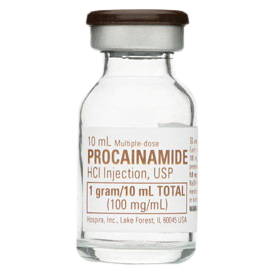
 Procainamide is a class IA antiarrhythmic medication used for the treatment of some stable wide‑complex tachycardias within the ACLS tachycardia algorithm. Because of its potential to cause hypotension, QRS widening, and QT prolongation, it should be used cautiously with continuous ECG and blood pressure monitoring.
Indications for ACLS
Within ACLS, procainamide may be used for stable patients with regular wide‑QRS tachycardia (monomorphic VT) when expert consultation is available and there is no severe heart failure or significant QT prolongation.
In the adult tachycardia with a pulse algorithm, procainamide is listed as an antiarrhythmic infusion option for stable wide‑QRS tachycardia along with other agents such as amiodarone and sotalol.
Route
For ACLS tachycardia management, procainamide is administered by intravenous infusion, typically through a dedicated line with continuous ECG and frequent blood pressure monitoring.
Dosing
Loading infusion (stable wide‑QRS tachycardia): 20–50 mg/min IV until the arrhythmia is suppressed, hypotension develops, QRS duration increases by more than 50%, or a maximum total dose of 17 mg/kg is given.
Maintenance infusion: 1–4 mg/min IV may be started after conversion, titrated to effect and patient response, with ongoing rhythm and blood pressure monitoring.
Precautions
Avoid procainamide in patients with prolonged QT interval or significant congestive heart failure because it can further prolong repolarization and depress myocardial contractility.
Stop the infusion if marked hypotension occurs, if the QRS complex widens by more than 50% from baseline, or if the rhythm converts, and seek expert consultation for further management.