 Tachycardia/tachyarrhythmia is defined as a rhythm with a heart rate greater than 100 bpm.
An unstable tachycardia exists when cardiac output is reduced to the point of causing serious signs and symptoms.
Serious signs and symptoms commonly seen with unstable tachycardia are: chest pain, signs of shock, SOA (short of air), altered mental status, weakness, fatigue, and syncope.
One important question you may want to ask is: “Are the symptoms being caused by the tachycardia?” If the symptoms are being caused by the tachycardia treat the tachycardia.
Causes
There are many causes of both stable and unstable tachycardia and appropriate treatment within the ACLS framework requires identification of causative factors. Before initiating invasive interventions, reversible causes should be identified and treated.
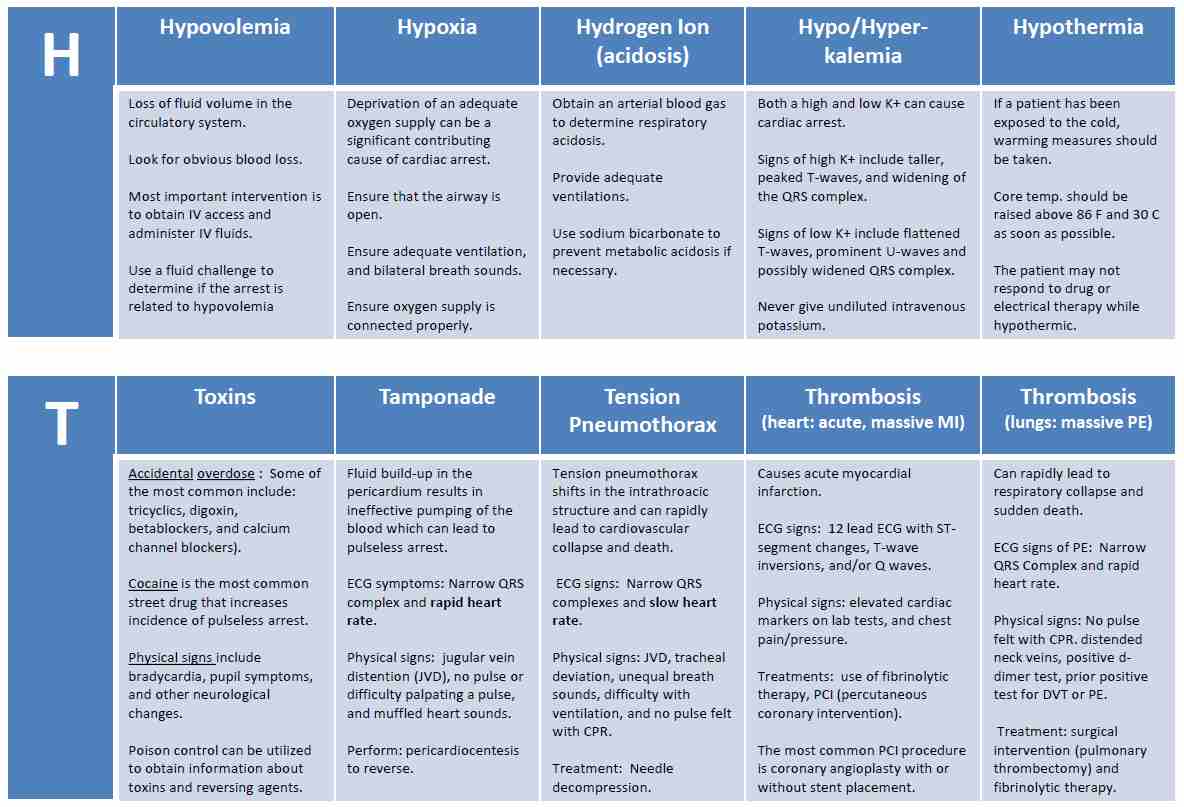
The most common causes of tachycardia that should be treated outside of the ACLS tachycardia algorithm are dehydration, hypoxia, fever, and sepsis. There may be other contributing causes and a review of the H’s and T’s of ACLS should take place as needed.
Click below to view the H and T’s table. When done click again to close the diagram.
H’s and T’s Table
Administration of OXYGEN and NORMAL SALINE are of primary importance for the treatment of causative factors of sinus tachycardia and should be considered prior to ACLS intervention.
Once these causative factors have been ruled out or treated, invasive treatment using the ACLS tachycardia algorithm should be implemented.
Associated Rhythms
There are several rhythms that are frequently associated with stable and unstable tachycardia these rhythms include:
- Supraventricular tachycardia (SVT)
- Atrial fibrillation
- Atrial flutter
- Monomorphic VT
- Polymorphic VT
- Wide-complex tachycardia of uncertain type
ACLS Treatment for Tachycardia
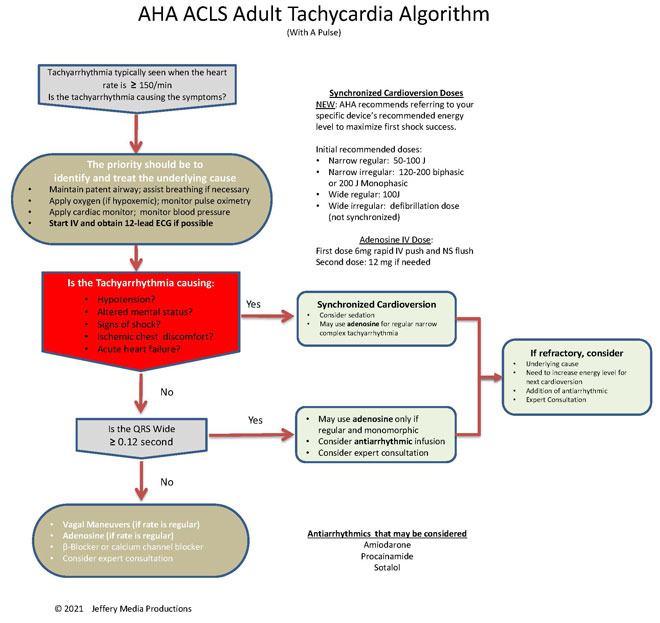
Click below to view the tachycardia algorithm diagram. When done click again to close the diagram.
Tachycardia Diagram
or Members Download the Hi-Resolution PDF Here(This will open in another window.)
The first question that should be asked when initiating the ACLS tachycardia algorithm is: “Is the patient stable or unstable?” The answer to this question will determine which path of the tachycardia algorithm is executed.
Unstable Tachycardia
Patients with unstable tachycardia should be treated immediately with synchronized cardioversion. If a pulseless tachycardia is present patients should be treated using the cardiac arrest algorithm.
The AHA no longer provides specific shock dose recommendations for synchronized cardioversion. Instead, they instruct to refer to your specific device’s recommended energy level to maximize first shock success.
For the purposes of a basic understanding of cardioversion, the information about general shock dosages and recommendations will remain in the content on this website.
The initial recommended synchronized cardioversion voltage doses are as follows:
- narrow regular: 50-100 J; i.e., SVT and atrial flutter
- Narrow irregular: 120-200 J biphasic or 200 J monophasic; i.e., atrial fibrillation
- Wide regular: 100 J; i.e., monomorphic VT
- Wide irregular: defibrillation dose (not synchronized)
Stable Tachycardia
Patients with stable tachycardia are treated based upon whether they have a narrow or wide QRS complex. The following flow diagram shows the treatment regimen for stable tachycardia with narrow and wide QRS complex.
- Stable (narrow QRS complex) → vagal maneuvers → adenosine (if regular) → beta-blocker/calcium channel blocker → get an expert
- Stable (wide/regular/monomorphic) → adenosine → consider antiarrhythmic infusion → get an expert
linten says
Hi Jeff, thank you for a great site. At which point do we check pulse in this algorithm? After the ABCs? Then if pulse less pulseless arrest algorithm?
Jeff with admin. says
This page should answer your question part of your question:
BLS SURVEY
Initially, (BLS survey you check responsiveness, activate emergency services, and check pulse. Once you are doing CPR you would check a pulse after 5 cycles of CPR. Once a defibrillator is attached and you can see a rhythm, you would perform rhythm checks after each 5 cycles of CPR. You would only perform pulse checks when you see a rhythm change to a rhythm that could be perfusing.
Kind regards,
Jeff
linten says
Thank you!
radiatelight says
For Vtach, monomorphic, isn’t the treatment choice Amiodarone 150mg? Why does it say adenosine? I know adenosine is preferred after vagal maneuvers for narrow-regular rhythms.
Jeff with admin. says
Adenosine is recommended in the initial diagnosis and treatment of stable, undifferentiated regular, monomorphic wide-complex tachycardia.
It is important to note that adenosine should not be used for irregular wide-complex tachycardias because it may cause degeneration of the rhythm to VF.
Kind regards,
Jeff
joana says
The patient has wide irregular tachycardia but with bp of 130/90. Asymptomatic. What will be the intervention? Are we going to give lidocaine or are we going to consider this as unstable wide irregular tachy and give unsynchronized cardioversion?or seek expert consultation?
Jeff with admin. says
If the patient is asymptomatic and completely stable then expert consultation would be in order. An expert will hopefully be able to determine the root cause of the tachycardia and deal with that. There would be no reason to treat a patient who is clinically stable and completely asymptomatic.
Kind regards,
Jeff
Ying Kwan says
Dear sir
What’s the meaning of vagal menuver? How to do it.
BR
Jeff with admin. says
A vagal maneuver is a technique by which you attempt to increase intrathroacic pressure which will stimulate the vagus nerve. This can result in slowed conduction of electrical impulses through the AV node of the heart. There are a number of ways to do it here are a couple:
Hope this helps. Kind regards, Jeff
magdi awad says
realy itis very nice and informative diagrams
JRWright says
According to the algorithm you are supposed to give a beta blocker or CA channel blocker with a narrow QRS complex and I was wondering if for AHA’s ACLS class I would be required to know the different drugs that can be given and the dosing for each.
Thanks
Jeff with admin. says
I would stick with putting to memory the information found on the tachycardia algorithm diagram. The diagram does not list the doses or even the names of the beta-blockers or CA channel blockers in the diagram. The last two times that I have taken the AHA ACLS certification, this was not brought up.
Kind regards,
Jeff
PRAFUL ZINZUWADIA says
What is the role of Amiodarone in treating SVT in immediate post delivery period? If Adenosine not available which drug should be used for managing SVT
Thanks.
PRAFUL ZINZUWADIA says
What means for SOA
Jeff with admin. says
SOA stands for “short of air.” It is basically the same thing as saying SOB or “short of breath.”
Kind regards,
Jeff
Praful Zinzuwadia says
Very very informative sir,please tell me which fluid is preferred during resuscitation
Jeff with admin. says
0.9% sodium chloride is usually the preferred IV fluid used during resuscitation.
Kind regards,
Jeff
Prague Zinzuwadia says
Very very informative sir
Douglas says
I’m a little confused about monomorphic VT- it looks like it is treated under the tachycardia algorithm- why isn’t it treated under the VF/VT algorithm? Is it just the polymorphic that is treated under the VF/VT algorithm?
Jeff with admin. says
If it is monomorphic with a pulse then it would be treated using the tachycardia algorithm. If there is no pulse, the monomorphic VT would be treated using the pulseless arrest algorithm (Pulseless VT/VF algorithm).
Kind regards,
Jeff
alejandrorojas says
A question regarding a-flutter and adenosine in a case of a stable patient: Should I use it or no?
Jeff with admin. says
I don’t think that adenosine would be the best option for a patient with stable atrial flutter. The adenosine would most likely slow the heart rate temporarily.
Kind regards,
Jeff
gabauer4 says
Following this algorithm, where would A.fib fall if the pt. is stable? (I understand that unstable would be treated with immediate synchronized cardioversion)….but since a fib is narrow qrs it says attempt vagal maneuvers, then give adenosine (only if REGULAR) and to my understanding a fib is a highly irregular, chaotic rhythm? So you wouldn’t give adenosine? would you still attempt vagal maneuvers? Thanks for any clarification you can offer!!
Jeff with admin. says
Atrial fibrillation would not be treated using the tachycardia algorithm unless the patient has a rapid ventricular rate and is unstable. This is why you first obtain an ECG. If the patient has stable atrial fibrillation with an RVR, the patient would be admitted to the hospital and worked up to identify the cause of the afib and then treat (Cardiology work-up). The patient would be admitted, placed on anticoagulant therapy and the RVR could be treated in a number of ways.
If the afib with RVR is unstable, then the patient would be treated using the AHA ACLS tachycardia algorithm. Vagal maneuvers would not be indicated. Synchronized cardioversion would be indicated (120-200 J)
Kind regards,
Jeff
Caren Asilwa says
Please help me understand the two terminologies; Monophasic and Polymonophasic tachycadia. why use adenosimne in regular narrow complex and regular wide complex tachycadia.
Caren{Mmust}
Jeff with admin. says
I believe what you are trying to say is monomorphic and polymorphic ventricular tachycardia. You will find an explanation of each one of these here.
Kind regards,
Jeff
jalmelia says
Very informative site. Thanks!