
Pulseless Ventricular Tachycardia
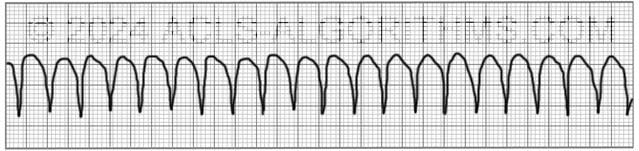
The pulseless ventricular tachycardia rhythm is primarily identified by several criteria. First, the rate is usually greater than 180 beats per minute and the rhythm generally has a very wide QRS complex.
Second, the patient will be pulseless and third, the rhythm originates in the ventricles. This is in contrast to other types of tachycardias which have origination above the ventricular tissue (in the atria).
Not all ventricular tachycardias are pulseless and therefore, pulselessness must be established prior to beginning an algorithm. This is accomplished simply by checking a carotid or femoral pulse.
Pulselessness with a tachyarrhythmia occurs because the ventricles are not effectively moving blood out of the heart and there is therefor no cardiac output. Many tachyarrhythmias of a rate >150 will deteriorate into pulselessness if timely treatment is not given.
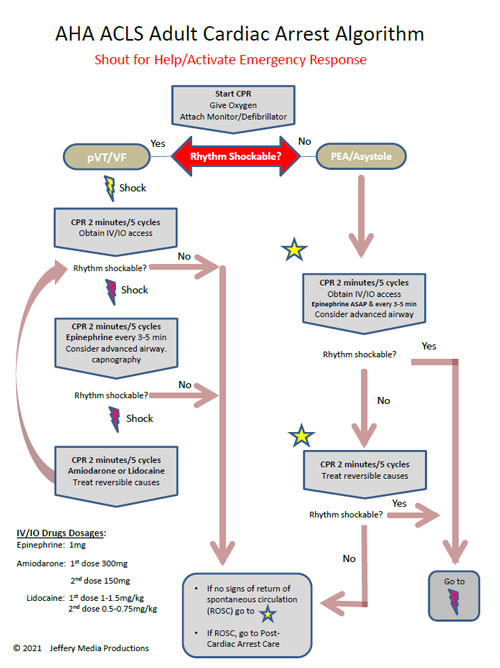
Pulseless ventricular tachycardia is treated using the left branch of the puslesless arrest arrest algorithm. Click below to view the pulseless arrest algorithm diagram. When done click again to close the diagram.
Pulseless Arrest Algorithm Diagram.»
Play the video below to see what a Pulseless Ventricular Tachycardia will generally look like on a defibrillator monitor. Allow several seconds for video to load.
Use the link below to try out the Megacode Simulator


I’ve been a RN for 10 years and have always dreaded taking ACLS until I found this wonderful website and all the tools it provides to assist any level of healthcare provider. THANKS
What is the order of meds if we are shocking for 3rd, 4th and 5th time… etc, and can we give Epi and Amiodarone in same cycle of chest compressions…. thanks.. Bill
Once epinephrine has been started, it is given every 3-5 minutes on its own time table. It does not need to be coordinated with the chest compressions. It is just given every 3-5 minutes. The recorder should call out when it is due. Amiodarone has two doses in the algorithm 150mg and then 300mg if needed. There is no place for subsequent doses. The first dose of amiodarone is given after the 3rd shock and the 2nd dose of amiodarone is given at the earliest after the 4th shock. The main thing that you need to make sure of is that each medication has time to circulate before it is repeated. 2-4 minutes of high quality chest compressions should be sufficient to circulate a medication in to the system.
Epinephrine and amiodarone can be given in the same cycle of chest compressions.
Kind regards,
Jeff
How do we identify pulseless VT/VF and PEA
You can review VT and VF here.
For PEA, if you have a patient that is unconscious with no pulse but they have a rhythm on the monitor that looks as if you should feel a pulse, you have PEA.
Kind regards,
Jeff
I am a new nurse and currently working in the ICU . This is very helpfull and am hoping to pass my ACLS ( dunno when to take it yet just starting my own study). thanks:)
Having trouble telling these apart – mono morphic v tach and pulse less v tach
The difference is not in the visual appearance. The difference is that one will have a pulse and the other will not. You can have monomorphic or polymorphic VT with or without a pulse.
Kind regards,
Jeff
“Not all ventricular tachycardias are pulseless and therefore, pulselessness must be established prior to beginning an algorithm. This is accomplished simply by checking a carotid or femoral pulse.”
- for instances that all other criteria were present but not the pulselessness, (the patient has a palpable pulse) how do we proceed? thanks..your site is of great help..
You would proceed by using the tachycardia algorithm. You would first need to establish whether the patient is stable or unstable. This would dictate what your next step according to the tachycardia algorithm would be.
Kind regards,
Jeff
This website is excellent! I have been a Registered Respiratory Therapist for 32 years, and I would personally recommend this website to anyone. It covers anything and everyhting you would need to prepare for acls. I’m very pleased, thank you!
why isn’t pulseless vtach treated like PEA in the acls algorithm?
There are two branches to the cardiac arrest algorithm. The right and left branch. The left branch is for treatment of Pulseless VT and VF and the right branch is for treatment of PEA/Asystole.
When a patient is in VT/VF, the shock (defibrillation) is used to temporarily stun the myocardial cells which will then “hopefully” reset to fire with the SA Node which is the pacemaker of the heart.
Shock (defibrillation) has been shown to be highly effective with the rhythms VT and VF. This is because there is an electrical current that is flowing in the heart and if these cells are stunned there is a good chance that they will reset to the firing of the SA node.
When you have a person who has PEA and asystole, there is no electrical current flow through the heart or at least not enough to be detected on the defibrillator/monitor. During this state it has been show that defibrillation does not produce any effective outcome.
Actually all of the interventions that are done in the right branch (PEA) are also carried out in the left branch (VT/VF) with the exception of adding shocks and a few other drugs which can be used for the treatment of the arrhythmia (VT/VF).
Kind regards, Jeff
This makes so much sense. I was always confused by the pulseless arrest algorithm because I thought pulseless VF and pulseless Vtach fit under the umbrella of PEA. Your website and customer service are excellent!
Love this website! It helped me to do well on ACLS two years ago and I am recert-ing tomorrow! Thanks
very use full for acls
REALLY IT IS VERY USEFUL SITE FOR ACLS .THANK YOU VERY MUCH
I took my acls test the other day. This site was xtremly helpful. Thanks so much. I got a 90% on test.