
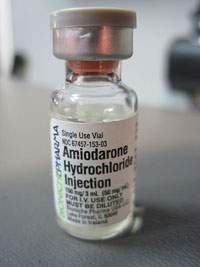
Amiodarone is a class III antiarrhythmic agent and is used for the treatment of various types of tachyarrhythmias. Because of the toxicity and serious side-effects of amiodarone, use it cautiously and do not exceed the cumulative total of 2.2 grams in 24 hours.
Indications for ACLS
Within ACLS, amiodarone is used for its antiarrhythmic properties and is effective for the treatment of supraventricular arrhythmias and ventricular arrhythmias.
The mechanism of action for amiodarone’s antiarrhythmic properties remains unclear, but it continues to be the primary antiarrhythmic medication for the treatment of ventricular fibrillation and ventricular tachycardia within the cardiac arrest algorithm.
For cardiac arrest, amiodarone is used after the third shock for ventricular fibrillation and ventricular tachycardia that is unresponsive to shock delivery, CPR, and vasopressors. For tachycardia with a pulse, amiodarone may be considered, and expert consultation should be obtained prior to its use.
Do not use amiodarone for individuals with polymorphic VT associated with a prolonged QT interval because this may worsen the patient’s condition.
Amiodarone is only used after defibrillation (or cardioversion) and epinephrine (first line medication) fail to convert VT/VF.
Route
Amiodarone can be administered by intravenous or intraosseous route.
Dosing
The maximum cumulative dose in a 24 hour period should not exceed 2.2 grams.
Within the VT/VF pulseless arrest algorithm, the dosing is as follows:
300mg IV/IO push → (if no conversion) 150 mg IV/IO push → (after conversion) Infusion #1 360 mg IV over 6 hours (1mg/min) → Infusion #2 540 mg IV over 18 hours (0.5mg/min)
For tachyarrhythmias that are not life-threatening, consider expert consultation before use.
For Tachycardia other than pulseless VT/VF, Amiodarone dosing is as follows: (see above note)
150 mg over 10 minutes → repeat as needed if VT recurs → maintenance infusion of 1mg/min for 6 hours
To prepare Amiodarone for an IV infusion, mix with D5W and give through an in-line filter. Alternatively, it is NOT necessary to dilute amiodarone for IV push administration and a filter is not necessary.
When infusions exceed 2 hours, amiodarone can absorb into the plastic used for standard IV bags. This will change the medication concentration. Therefore, when an infusion exceeds 2 hours use a glass or polyolefin bottle for the administration container.
Sherman says
hi, can someone please explain what is ACLS guidelines for example like — 150 mg over 10 minutes
Patient Care Record shows on 12/19/2022:
911 call was made 12/19/2022 at 9:52AM
Emergency responder’s arrived in 27 years old home at 9:58AM
10:11 AM – Naloxone 2 Milligrams (mg)
10:11 AM – Epinephrine 1 Milligrams (mg)
10:13 AM – Heart rate pulse: 97
10:15 AM – Epinephrine 1 Milligrams (mg)
10:15 AM – Heart rate pulse: 100
10:17 AM – Heart rate pulse: 102
10:18 AM – Epinephrine 1 Milligrams (mg)
10:18 AM – Heart rate pulse: 100
10:19 AM – Patient response improved
10:19 AM – Amiodarone 300 Milligrams (mg)
10:22 AM – Heart rate pulse: 100
10:24 AM – Amiodarone 150 Milligrams (mg)
10:24 AM – Heart rate pulse: 94
10:27 AM – Heart rate pulse: 84
10:30 AM – Heart rate pulse: 48 (Death was Pronouncement 10:34AM)
They estimmated his WEIGHT as 198.4 pounds but autopsy found he was 143 POUNDS
however they administered 450 mg over 5 minutes in this case at 10:19 & 10:24AM
ACLS says
The ending of this scenario with the patient developing bradycardia doesn’t make sense. He should’ve been treated with the bradycardia algorithm when his heart rate dropped to 48/min.
Regarding amiodarone it is acceptable to get 2.2 grams in a 24 hour. There’s not much here to determine exactly what the cause of death was, but I think it’s unlikely that it was the amiodarone.
Kind regards,
Jeff
Many says
According to the protocol of cardiac arrest with VF or VTp it’s recommander to defibrillate, give adrenalin, defibrilate again twice if the rythm still chocable and then to Give Amiodarone or Lidocaine.
I want to know if Amiodarone can be administrated before adrenaline, if not Why or why adrenaline is given before Amiodarone.
Thx.
ACLS says
Epinephrine is administered before amiodarone during cardiac arrest because it helps to increase the heart rate and blood pressure which can improving blood flow to vital organs. This initial boost in circulation can enhance the chances of successful defibrillation and increase the likelihood of restoring a stable heart rhythm. Amiodarone, on the other hand, is an antiarrhythmic medication used to treat and prevent abnormal heart rhythms. It’s given after epinephrine to help stabilize the heart’s rhythm and prevent further arrhythmias.
Rane says
Actually, the guideline for vfib/pVT is defibrillate, defibrillate, epi, defibrillate, amiodarone 300mg. Defibrillation is the recommended 1st line of treatment for vfib/pVT to reset the heart from its quivering motion. if it is refractory after 2 attempts. Epi is given every 3-5 mins. If still refractory after 3 attempts, amiodarone 300 mg is given. Why is epi given before amio? I dont know, I guess because amio is the last ditch effort for vfib/p/VT.
Manuel says
Hello
During Vfib or pVT when would you give the second amiodarone bolus? Right after the next CPR cycle (given the rythm is still the same) or do you have to wait three more shocks to administer the second bolus?
And if after the second bolus the patient is still in Vfib or pVT can we give a third, fourth, and so on boluses until the maximum daily dose? Is there any evidence on that?
Thank you in advance.
ACLS says
The second bolus of amiodarone may be given after the 4the shock if it is needed for refractory VF or pVT. A third bolus of amiodarone is not recommended in the guidelines and this would be at the physicians discretion and with the 2.2 gram 24 hour maximum cumulative dose in mind.
Kind regards, Jeff
Zeinab Said says
If patient received first dose Epinephrine for PEA and next cycle showed VF do we have to wait 3 shock to give amiodaron or can be given after the first shock ?
ACLS says
The amiodarone would be given after the 3rd shock.
Kind regards,
Jeff
Bridget says
Hi Jeff, when a pt in VT is defibrillated and converts to PEA, should Amniodarone still be given, or does the algorithm shift to PEA and no anti arrhythmic is indicated?
ACLS says
The algorithm would shift to the right branch and amiodarone would not be given unless the ventricular fibrillation reoccurred.
Kind regards,
Jeff
A says
Hi. May I know what is the normal cumulative dose of amiodarone? At what cumulative dose, it is considered to cause amiodarone pulmonary toxicity
ACLS says
The maximum cumulative dose in a 24 hour period is 2.2 g
Kind regards,
Jeff
Adel says
Is it necessary to dilute amiodarone before injection?
And how much time dose it necessary to push 300mg amiodarone?10 min??
Thank you
ACLS says
During cardiac arrest amiodarone can be given in 10 mL of the diluent that is used to dilute it or undiluted if it is in the solution form from the vial.
During cardiac arrest amiodarone is pushed the same way that Epinephrine is pushed (rapidly) and always followed by 20 mL of normal saline.
Kind regards,
Jeff
Alski says
Some text recommends Amiodarone to be followed by D5W. Is it true?
ACLS says
Amiodarone should be diluted with D5W. However, normal saline can be used as a flush after Amiodarone administration. D5W is not necessary for the flush.
Brittany says
If the patient is in pulseless v tach and shocked three times and then regains a pulse but remains in v tach can Amiodarone 300 mg be administered or should only it be 150 mg or is it then up to the physicians discretion?
ACLS says
To treat all acute tachyarrhythmias in adults, amiodarone can be given IV 150 mg over 10 minutes, followed by a 1 mg/min infusion for 6 hours, followed by an infusion at 0.5 mg/min. The recommended total dose over 24 hours should not exceed 2.4 grams.
Kind regards,
Jeff
Kelly Gee says
If ROSC is achieved and patient returns back to VFib arrest. Do we restart the amiodarone algorithm? Meaning do we give another initial dose of 300mg IVP.
Thank you
ACLS says
There is no clarity in the American Heart Association ACLS guidelines regarding this question. The maximum dose for a 24 hour period is 2.2 g of amiodarone and that would need to be maintained.
The most likely option here would be for the physician running the code and the team to determine the best option. My guess would be they would probably start off where they had left during the initial code. A second option would be to start at the beginning using 300 mg, but I think this is unlikely.
Kind regards,
Jeff
C says
If a patient achieved ROSC after giving amiodarone 300mg bolus during vfib arrest and are now in a sinus rhythm, are there any situations where you would give a 150mg bolus x10 mins once ROSC is achieved and before starting the maintenance 1mg/min infusion?
ACLS says
There would not be any situation where you would give the bolus unless the person was to go back into cardiac arrest. And as a matter of fact, he would not need to give the post arrest infusion unless there are continued arrhythmias during the post arrest phase.
Kind regards,
Jeff