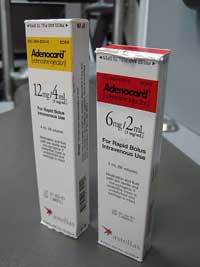
When vagal maneuvers fail to terminate stable narrow-complex SVT, the primary medication of choice is adenosine. For the unstable patient with a regular and narrow QRS complex, adenosine may also be considered prior to synchronized cardioversion.
Adenosine is the primary drug used in the treatment of stable narrow-complex SVT (Supraventricular Tachycardia). Now, adenosine can also be used for regular monomorphic wide-complex tachycardia.
When given as a rapid IV bolus, adenosine slows cardiac conduction particularly affecting conduction through the AV node. The rapid bolus of adenosine also interrupts reentry (SVT causing) pathways through the AV node and restores sinus rhythm in patients with SVT.
When injected into the body, adenosine is rapidly absorbed by red blood cells and blood vessel endothelial cells and metabolized for natural uses throughout the body. In light of this adenosine should be administered by RAPID intravenous bolus so that a significant bolus of adenosine reaches the heart before it is metabolized.
A change from the 2010 guidelines now has adenosine given up to two times rather than three.
Dosing
The first dose of adenosine should be 6 mg administered rapidly over 1-3 seconds followed by a 20 ml NS bolus. If the patient’s rhythm does not convert out of SVT within 1 to 2 minutes, a second 12 mg dose may be given in a similar fashion. All efforts should be made to administer adenosine as quickly as possible.
A lower initial dose of 3mg should be used for patients taking dipyridamole or carbamazepine as these two medications potentiate the effects of adenosine.
Also, prolonged asystole has been seen with the use of normal doses of adenosine in heart transplant patients and central line use. Therefore, the lower dose (3mg) may be considered for patients with a central venous line or a history of heart transplant.
Precautions
Some side effects of adenosine administration include flushing, chest pain/tightness, brief asystole or bradycardia.
Make sure that adenosine is not used for irregular, polymorphic wide-complex tachycardia and unstable VT. Use in these cases may cause clinical deterioration.
Return to ACLS Drugs Main Page.
Thiruselvi Subramaniam says
Is charging on the defib machine and discharging on the patient when it is a pVT or VF accepted ? Saves time I think especially when we say that every second counts and sometimes there is a delay when charging with the paddle on the
If it is cardioversion it makes sense to charge and discharge on the patient .
ACLS says
Charging should NOT take place until patches/paddles have been placed on the patient. Placement prior to charging is important because safety is important. Charging before pads are placed on the patient increases the risk of accidental early discharge and can result in an electrical arc which can injure the patient and the technician.
Kind regards,
Jeff
Kristin m perkins says
I know this isn’t probably meant for a patient who received this medication. I had Covid in June’20. In the 5 weeks I was sick, my heart rate would take off. 170 bpm +. After several episodes, the last one being over 4 hours long . I went to the ER. They administered this 6mg dosage. The doctor lifted my legs in the air while I was on my back so I was at 90 ° angle. He said it would feel miserable for a few seconds ( it did, nurses and Doc cheered me On to keep breathing) and it dropped my heart rate to 120 bpm.
Amazing. I was put on a beta blocker, and I am still on it.
Chris says
Hello
This website is the only source that I’ve found recommending usage of adenosine in UNSTABLE patients, as an option. While I see it very reasonable, there is no such an option mentioned in ERC or AHA guidelines. There is some evidence for this practice, summarised in BET 1 article. Why, in your opinion, is not this approach included in those big, impactful papers?
Best regards
Chris
ACLS says
The reason why I mention it is because the American Heart Association directly in their algorithm provides for the use of adenosine prior to synchronized cardioversion while you prepare for synchronized cardioversion.
I have never gotten a clear specific answer why they do not cover this in more detail in the book. It’s very strange that they put it right in the algorithm underneath cardioversion in box 4, yet they do not even mention it in the written content.
It is reasonable, it’s directly on the Tachycardia algorithm in Box 4, and the literature seems to support it so I include it.
Sorry I couldn’t be more helpful with my answer.
Kind regards,
Jeff
Christiane Hilker says
I don’t know. I am guessing and not after my review of some paramedics training manual (LearningExpress) that circumventing the suggestion “I am in control of my mind and body (and environment)”(Learningexpress) is somewhat difficult.
I appreciate the ability to communicate.
Stacey says
Where’s the literature to support dose reduction with carbamazepine and dipyridamole?
ACLS says
The American Heart Association does not address the use of these two medications within the American Heart Association ACLS protocols.
Kind regards, Jeff
Astryd says
I’m guessing Diltiazem was given because maybe when the pt. converted for those short periods of time it was enough to identify the rhythm ? As an Afib/Aflutter? Or because the pt. wouldn’t stay in sinus they wanted to try rate controlling….
Maybe could not electro-cardiovert because of lack of anticoagulation?
Daniel Lawson says
Is there a maximum amount of adenosine that can be given to one patient for SVT? In a day or certain amount of time?
I had a patient who’s SVT wouldn’t stay converted. She got an initial 6 mg. Instead of 12 mg, they did another six. She converted, but then reverted back to SVT. She was than given a 3rd dose of 6 mg and started on diltiazem drip.
Really not sure why diltiazem was ordered in this situation? She converted for a bit, but then went back into SVT. She was given a 4th 6mg dose of adenosine, and started on Esmolol. Again, the patient converted for a brief time but then reverted back to SVT. Was given a 6th dose of adenosine 6mg, after that the patient was taken to ICU, not sure what happened from there.
I was completely baffled by the treatment of this patient, I’ve never witnessed so many doses of adenosine given, and all 6 mg doses. Also, I have not seen a diltiazem drip given for SVT.
The patient was hemodynamically stable throughout, and asymptomatic, so I can understand not cardioverting, but I dont really understand why certain meds were given.
ACLS says
There is not a maximum amount of adenosine that can be given in a period of time. Adenosine is rapidly metabolized within seconds in the body and it is one of the most common molecules that is produced by the body. ATP adenosine triphosphate.
Every single cell in the body utilizes adenosine and this is why it is so rapidly metabolized.
Typical doses are 6 mg and 12 mg. I have seen literature that supports the use of 18 mg, but this would be in very rare cases and this can produce prolonged asystole when given as a bolus.
Kind regards,
Jeff
Ryan says
There’s actually research to support the use of both diltiazem and esmolol in SVT patients. For reference:
Diltiazem: https://www.ncbi.nlm.nih.gov/pmc/articles/PMC6485380/
Esmolol:
Intravenous esmolol for the treatment of supraventricular tachyarrhythmia: results of a multicenter, baseline-controlled safety and efficacy study in 160 patients. The Esmolol Research Group. Am Heart J. 1986 Sep;112(3):498-505. doi: 10.1016/0002-8703(86)90513-2. PMID: 2875641.
The esmolol study is admittedly older, though esmolol is actually FDA approved for the treatment of SVT (at least in certain post-op patient populations).
So, the thinking was probably, the patient isn’t converting (well, at least not permanently) with adenosine, so let’s try some other known treatments. While I’m not as certain if there’s any solid data backing up using those drugs after attempting conversion with adenosine, there’s certainly data that they can convert a patient if given INSTEAD of adenosine. And given the extremely rapid metabolism of adenosine in the body, I would think it’s reasonable to deduce that a patient with refractory SVT that doesn’t convert (or does but only temporarily) with adenosine may very well have better luck with an alternative treatment, with likely little impact from the prior doses of adenosine (as again, rapid metabolism). The idea of trying esmolol after diltiazem treatment failure, however, is a bit more dubious, as I would imagine you’ve got a decent chance of hypotension if the patient was normotensive before treatment. It’s still not the craziest thing I’ve seen though, as I’ve seen actually seen digoxin prescribed for SVT that wouldn’t respond to anything else (so, adenosine failed, as did a calcium channel blocker and/or a beta blocker, it might’ve been both, I forget in this particular case). While this might theoretically work, it very much felt kinda like using a nuke to deal with an ant hill…I mean, even amiodarone is less problematic
And note, to be fair, the calcium channel blockers/beta blockers (so diltiazem and esmolol in this particular case, though others in the class are occasionally used) are technically not typically included in ACLS guidelines, but I can understand wanting to try them before jumping to amiodarone/procainamide. They’re far less side effect ridden, are far more quickly metabolized (in case something goes wrong), and, as I said, supported to some extent by the literature.
ARUN says
GREETINGS FROM ARUN….
I AM AN AHA INSTRUCTOR….. STILL SOMANY DOCTORS NOT ACCEPTING THAT ADENOSINE IS THE DRUG OF CHOICE FOR TACHYCARDIAS, THEY ARE RECOMMENDS CARDARONE …I CAN’T UNDERSTAND THAT… CAN U PLEASE VIVID THAT WHY AHA RECOMMENDS ADENOSINE RATHER THAN CARDARONE…..
REGARDS,
ARUN (INDIA)
ACLS says
Adenosine is recommended for specific types of tachycardia. Specifically, tachycardia that has an electrical impulse that originates in the atria. SVT and some regular wide-complex monomorphic tachycardia. For these types of tachycardia, adenosine has proved to be more save and effective than cardarone.
Adenosine is not the medication of choice for VF, and true VT that has its origin of electrical impulse in the ventricles. Cardarone would be preferred and is recommended by the AHA in this case.
Here are a couple of links that might help:
Wide Complex Tachycardia
ECC Guidelines 1
ECC Guidelines 2
Kind regards,
Jeff
Kelli Anderson says
Some sources indicate the dosing of Adenosine is cut in half if the patient has a central line. Why is this not included in guidelines?
ACLS says
This is mentioned in the Guidelines here: AHA Guidelines Ref for Adenosine Central Line Use
Kind regards, Jeff
RHONDA STAFFORD says
IS IT EVER ACCEPTABLE TO GIVE ADENOSINE 18 MG….I WOULD BE REFUSING TO GIVE R/T ACLS GUIDELINES TO NOT COVER US….
Jeff with admin. says
It is not recommended or discussed within the AHA guidelines, but It may be acceptable in certain situations. Here are a couple of links to research articles regarding the topic.
Adenosine Article 1
Adenosine Article 2
Kind regards, Jeff
Suja says
What’s the reason for giving the second dose of adenosine after 2 minutes why not immediately
Jeff with admin. says
I do not know the reason for delaying the second dose of adenosine for two minutes. I could not find a explanation for this anywhere. The half-life of adenosine is less than 10 seconds and so the adenosine would be completely metabolized within a maximum time of 30 seconds.
It would seem logical that a second dose could be given after 30-60 seconds, but the guidelines clearly state that it may be repeated after 1-2 minutes.
Here is the reference from the AHA website: AHA Adenosine
Kind regards,
Jeff
Ryan says
If I had to guess, it’s an abundance of caution type of thing. Remember that adenosine is only really used (at least repeatedly) in a STABLE patient, so what’s the harm in waiting an extra minute? It not only ensures the drug is completely metabolized prior to the next dose, but also gives time to reasses rhythm and ensure that the patient is still in SVT and that the rhythm is actually what you originally thought it was, as adenosine admistration can occasionally result in either a change of rhythm or an unmasking of sorts of a ventricular arrhythmia that wouldn’t respond to an additional dose of adenosine.
So, to sum it all up, the additional time causes little harm (as the patient is relatively stable) but allows you as the healthcare provider to reasses the patient and ensure that adenosine is still the best course of action, while also ensuring that the prior dose has both done everything it can and was fully metabolized by the body to the point where another dose can be given without any consideration (at least from an overdose/prolonged asystole standpoint) to the previously admistered dose.
Martin says
I have been told that you can give adenosine three times! 6 mg, 12 mg, and 12mg. Is this true?
Jeff with admin. says
Prior to 2010, the American heart Association guidelines called for the administration of 6 mg, 12 mg, and 12mg.
After 2010, the 3 dose schedule was dropped for the two doses of 6mg and 12mg.
I was never able to determine the exact reason for this change, however my assumption was that the third dose of 12 mg was not typically needed and SVT conversion what are usually accomplished with the two initial doses.
Many providers still include the third dose of 12 mg on the schedule and this is fine. It’s just not included in the American heart Association guidelines any longer.
Kind regards,
Jeff
Jorge says
I imagine there is an element of doing the same thing and expecting different results. With the half life being so short, you do not build up a loading dose or therapeutic level so why try the same thing?
Jorge
ACLS says
There are reports of conversion occurring with the third dose of 12 mg. There are also some physicians that will go up to 18 mg but I have never seen this performed myself. Higher doses can cause prolonged asystole.
Kind regards,
Jeff