There are three medications used in the bradycardia algorithm: atropine, epinephrine, and dopamine. Read about each drug and its use within the bradycardia algorithm below.
When symptomatic bradycardia occurs, the primary objective is to identify and treat the cause of the problem. Medications are indicated if symptomatic bradycardia cannot be corrected by treating an underlying cause or if the cause cannot be determined.
2020 AHA UpdateThe single-dose administration of atropine was increased from 0.5 mg to 1 mg. Now give 1 mg for the first dose and then repeat every 3-5 minutes at the 1 mg dose. Also, the dopamine infusion rate for chemical pacing was changed to 5-20 mcg/kg/min. The previous rate from the 2015 guidelines was 2-20 mcg/kg/min.
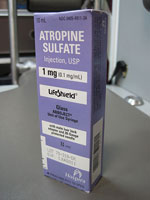
Atropine
Atropine is the first line medication for the treatment of bradycardia. The administration of atropine typically causes an increase in heart rate. This increase in the heart rate occurs when atropine blocks the effects of the vagus nerve on the heart. When the vagus nerve is blocked, the SA node increases its rate of electrical discharge and this, in turn, results in the increased HR.
Use atropine cautiously in the presence of myocardial ischemia and hypoxia because it increases oxygen demand on the heart and can worsen ischemia.
The dosing for Atropine is 1 mg IV every 3-5 minutes as needed, and the maximum total dosage for administration is 3 mg.
Atropine should be avoided with bradycardia caused by hypothermia and, in most cases, it will not be effective for Mobitz type II/Second-degree block type 2 or complete heart block.
You may have read that atropine is not effective for Mobitz II (2nd-degree block type II) and complete heart block (3rd-degree block)
Click here to find out why
Atropine for Mobitz II and Complete Heart Block
In your AHA provider manual, you will see it stated in the bradycardia section that atropine is not effective for Mobitz II and complete heart block. I have had a number of people ask why it is not effective. Read below for the explanation.
First, let’s look at atropine and how it works. Atropine increases the firing of the sinoatrial node (atria) and conduction through the atrioventricular node (AV) of the heart by blocking the action of the vagus nerve.
With 3rd-degree block, there is a complete block and disassociation of the electrical activity that is occurring in the atria and ventricles. Since atropine’s effect is primarily on the SA node in the atria, a 3rd-degree block would prevent its effect on the SA node from influencing the rate of ventricular contraction which is needed to improve perfusion.
With Mobitz-II, aka, second-degree AV block type II, the situation is similar. There is a partial block in the electrical impulses from the atria (SA) to the ventricles, and thus the effects of atropine would not significantly change the status of the ventricles. This block can also rapidly progress to 3rd-degree block.
To summarize, atropine may speed the firing rate of the SA node (atria), but the ventricles are not responding to anything the atria (SA node) puts out. Thus, the heart rates will not increase.
There may be some action at the AV-node with atropine, but the effect will be negligible and typically not therapeutic. In most cases, atropine will not hurt the patient with 3rd-degree block unless they are unstable and cardiac pacing is delayed in order to administer atropine.
Caution with Atropine
It is important to note that Mobitz II and complete heart block may be associated with acute myocardial ischemia. If atropine is used when there is ongoing myocardial ischemia this may worsen myocardial ischemia because of an increase in oxygen consumption. The increased heart rate will also reduce the diastolic filling time which may worsen coronary perfusion.
Since new-onset Mobitz II and complete heart block are commonly associated with myocardial infarction, it is recommended to maintain a slow HR (50-60) in order to increase the diastolic filling time. Any time you increase HR, the diastolic filling time is reduced and this reduces the coronary perfusion.
Transcutaneous pacing should be the first line action for symptomatic Mobitz II and symptomatic complete heart block. It is very safe & less painful than in previous times due to technological improvements. Research has shown that most individuals can tolerate > 15min of transcutaneous pacing without significant pain or discomfort.
Now back to the bradycardia drugs
Epinephrine and Dopamine
Epinephrine and dopamine are second-line drugs for symptomatic bradycardia. They are both used as infusions in the bradycardia algorithm if atropine is ineffective.
ACLS guidelines state that if bradycardia is unresponsive to atropine, an equally effective alternative to transcutaneous pacing is the use of an IV infusion of the beta-adrenergic agonists (dopamine or epinephrine).
Dosing:
IV infusion for bradycardia:
- 1mg epinephrine is mixed with 500ml of NS or D5W. The infusion should run at 2-10 mcg/min and titrate to the patient’s response.
- Dopamine 400 mg is mixed with 250 ml NS. Begin the dopamine infusion at 5 to 20 mcg/kg/min and titrate to the patient’s response.
The goal of therapy is to improve the patient’s clinical status rather than target an exact heart rate.
Precautions
Prior to the use of ACLS drugs in the treatment of symptomatic bradycardia, contributing factors of the bradycardia should be explored then ruled out or corrected.
Mark says
Hi just looking at this topic from a different view point, with a bradycardia from a new 2nd degree type 2 AV block with narrow QRS (so likely AV node, not infranodal) what about giving a fluid bolus? increase the preload and stretch, starlings law wouldn’t this increase the intrinsic rate? and if this doesnt work pacing?
Regards
Mark
Jeff with admin. says
This recommendation would not be based on current literature. Bradycardia should be treated initially with atropine then pacing.
Kind regards,
Chris
Rama Krishna says
Hi, I think starlings law increases force of contraction… not heart rate
Sharon says
Atropine is a parasympatholytic blocker. There are no parasysmpathetic fibers in the ventricles so Atropine would have no influence where it “can’t go”. This is most likely why it had been traditionally held in second degree Type II and 3rd degree heart blocks – the wider the complex the lower in the conduction system the rhythm originates. With the 2010 guideline changes, I believe the pendulum swung back to saying try the Atropine in case the block is not that low in the conduction system WHILE you are reaching out and setting up for TCP – it’s often quicket to get the drug on board than the TCP set up.
dhee says
I had tavb case in ER few days ago. Patient condition : BP110/70, HR 38, LOC and SOA, peripheral perfusion was good. cardiologist gave the patient atropine and NE. I didnt talk much with him. Jeff what do you think about NE in bradycardia case? Why didnt he give epi?
Jeff with admin. says
It is perhaps due to Norepineprine’s coronary vasodilatory properties as well as its ability to increase heart more subtly than epinephrine.
Kind regards,
Jeff
Nelhom says
Jeff you are just great. If you bradycardia and hypotension and the patient was in cardiac arrest previously, and the patient is in septic shock, epi and dopa are after norepinephrine. Even, dopa is not recommended because it increases mortality due to arrhythmias( dopa trigger arrhy).
Nelhom
Heather says
One of my practice tests keeps giving the atropine dose as 0.5-1 mg. I can’t find anywhere that says it’s ok to give 1mg of atropine as an initial dose for bradycardia. Is this an ok practice or a trick question?
Jeff with admin. says
The correct single dose for atropine to be use in the bradycardia algorithm is 0.5mg IV push.
Kind regards,
Jeff
Nancy Bernard says
I always thought Atropine was not used in Mobitz II and CHB because of where it works-the SA node. In high degree blocks the electrical signal does not pass through the Bundle of His and so increasing the number of signals generated by the SA node will not increase the ventricular rate. It is the ventricular rate that determines cardiac output so you need to go to a more direct approach with a pacemaker or epinephrine
Jeff with admin. says
Yes, this is true. Atropine may have not have an effect because it primarily acts by increasing the firing of the sinoatrial node (atria) and conduction through the atrioventricular node (AV) of the heart. Basically, with 3rd degree block there is a complete block and disassociation of the electrical activity that is occurring in the atria and the ventricles.
Atropine may speed the firing rate of the SA node (atria), but the ventricles are not responding to anything the atria (SA node) puts out. Thus, the heart rates will not increase.
There may be some action at the AV-node with atropine, but the effect will be negligible and typically not therapeutic. Atropine in most cases will not hurt the patient in with 3rd degree block unless they are unstable and you delay pacing to give atropine.
However, the major reason why you would not want to give it is because of the risk of worsening already existing myocardial ischemia as is common with a new onset of 2nd degree block Type 2 or complete heart block.
The explanation on the site was vague regarding where atropine has it affects. I have modified this section and hopefully it will be a little more clear.
Kind regards,
Jeff
Bruno says
Hello,
How would you set up the Dopamine and Epi infusions?
Jeff with admin. says
The standard concentration for a dopamine drip is 800mg in 500 ml D5W or 1600 mcg/ ml. Dopamine infusion is a weight based infusion so you would need to calculate the infusion rate. For bradycardia, you will infuse at 2 to 10 mcg/kg/min and titrate based on the patient’s response.
Here is the formula for calculating the infusion rate:
Ordered dose x patient weight in kilograms x 60 minutes divided by the solution concentration.
So here is an example:
The patient weighs 50 kg and you want to infuse the drip at at 6 mcg/kg/min then you would calculate it as follows:
6 mcg x 50 kg x 60 minutes divided by 1600 mcg/ml = 11.25 ml/hr
The standard concentration for an epinephrine drip is 3mg in 250 ml D5W or 3000 mcg/250 ml = 12 mcg/ml. So if you want your epinephrine infusion to run at 6 mcg/min then you would calculate it as follows. First, to simplify the drip calculation for any drug ordered as mcg/minute calculate the infusion rate for 1 mcg/minute of 3000 mcg/250 ml solution (12 mcg/ml) as shown here:
1 mcg x 60 min
———————— = 5 ml/hour (infusion rate)
12 mcg/ml (drug concentration)
Once you’ve calculated the infusion rate for 1 mcg/min which is 5 ml/hour, you can
easily determine the titration rates, as shown below:
2 mcg x 5 = 10 ml/hour (2 mcg/minute)
3 mcg x 5 = 15 ml/hour (3 mcg/minute)
4 mcg x 5 = 20 ml/hour (4 mcg/minute)
5 mcg x 5 = 25 ml/hour (5 mcg/minute)
Kind regards,
Jeff
rajesh says
Why is noenates contra indicated for atrophine
Jeff with admin. says
I have done some searching to find out the answer and the only thing that I could clearly deduce was that research has shown no proven benefit of routine use of atropine in neonatal resuscitation.
If I do discover anything else about this, I will post it on the site.
Kind regards,
Jeff
k deshon says
I just wanted to add that in PALS, we teach not to use atropine routinely for infants and children because they have a much higher vagal tone than adults If their bradycardia is not due to vagal stimulation, and you give atropine, their heart rate will shoot way up, and you will still have cardiovascular compromise, just with the opposite problem (tachycardia). PALS teaches that you only use atropine if you vagaled them or watched them vagal (suction, etc.). I do not teach NRP, but I assume it is similar reasoning. Or, it could be that they cannot handle the increase in myocardial O2 demand/consumption.
Angela Turner says
Why is there a difference in an Epi infusion for post cardiac arrest care compared to during an arrest. In the post care it is weight based, whereas most of the time it is a standard 2-10 mcgs per min.
Thanks,
Angela
Jeff with admin. says
I believe that the weight based is because that is how the folks doing the research on post-cardiac arrest care ran their trials. I think weight based was what they had the best outcomes with as compared to the non-weight based.
Kind regards,
Jeff
dualdoc says
I think that you both are referring to Dopamine. Epi is always infused as a standard 2-10 mcgs/min. Am I wrong?
Jeff with admin. says
Hi Dualdoc,
Thanks for your input. Just passing this along. For post-cardiac arrest the Epinephrine is weight based. Reference is page 76 of the AHA Provider manual.
States: Treatment of Hypotension–Epinephrine 0.1-0.5 mcg/kg/min titrate to achieve a minimum SBP > 90 mmHg or mean arterial pressure of > 65 mmHg.
(70kg adult this would work out to 7-35 mcg/min)
Kind regards,
Jeff
Andirn says
Hello
I have also read that epi shoud be used cautiously when MI is suspected. In type 2/2 and type 3 would you use dopamine infusion instead….OR…is the epi ok bc it’s an infusion and not rapid IVP?
Thanks!
Andi
Jeff with admin. says
Either epinephrine or dopamine is ok. Due to the fact that the infusion dose is very small and you will not have the profound affect as when you give IVP. The epi drip should not increase the myocardial oxygen demand any more than the dopamine. If MI suspected PCI should be the priority.
Kind regards,
Jeff
Stavan Patel says
Hello Jeff, I was wondering if Atropine fails do you go straight to TCP or you can opt and go for medication? Also only time you would go with TCP 1st instead of atropine is if patient has poor blood perfusion?
Jeff with admin. says
If the pt has poor perfusion and atropine fails, you would opt for TCP. If no TCP is available or if the pt. has questionable perfusion, you can use dopamine or epinephrine infusion as a replacement for TCP.
Kind regards,
Jeff
SHIRLEY says
I would like to know about adrenaline dilution and the dosage in acls
Jeff with admin. says
Epinephrine vials are also labeled by concentration of a ratio of medication per mL.
CONCENTRATION
1:1,000=1mg/ml
1:10,000=0.1mg/ml
So if you use 1:1000 you would mix 1mg with the 500 ml of NS or D5W.
– 1:1000 is much more concentrated
And if you use 1:10,000 you would mix 10ml with the 500 ml of NS or D5W.
Kind regards,
Jeff
Brandon says
Wiki indicates Atropine is a negative donotrope at AV node. Wouldn’t this slow things down?
Jeff with admin. says
Atropine blocks the action of the vagus nerve, a part of the parasympathetic system of the heart whose main action is to decrease heart rate. Therefore, its primary function in this circumstance is to increase the heart rate.
It is classified as an anticholinergic drug and increases firing of the SA Node by blocking the action of the vagas nerve on the heart resulting in an increased heart rate. The anticholinergic actions of the drug are of prime importance with the use of atropine in ACLS.
Also take a look at this list of positive chronotropic drugs at Wiki
Kind regards, Jeff
TOOT says
WHY THE ATROPINE SHOULD BE AVOIDED IN THE HYPOTHERMEIC BRADYCARDIA?
Jeff with admin. says
Like many medications, atropine has been shown not to be effective when a person is in a hypothermic state. The patient should be warmed appropriately for atropine to be effective. This is true for transcutaneous pacing as well.
Kind regards,
Jeff
K R says
First I’m loving your site more and more as I work my way through it.
And now, here’s a question.
The red box above says, “Atropine should be used cautiously in the presence of myocardial ischemia and hypoxia since it increases oxygen demand of heart and can worsen ischemia.”
Does this accurately imply that Dopamine and Epinephrine should also be “used cautiously in the presence of myocardial ischemia and hypoxia”?
Additionally, when reading your response to “You may have read that Atropine is not effective for Mobitz II and Complete Heart Block, Click here to find out why»” would it be correct to replace all instances of “Atropine” with either Dopamine or Epinephrine?
Jeff with admin. says
Answer to first question: Dopamine and Epinephrine are by their titrated dosing “used cautiously” since the drip rate is controlled to keep the heart rate around 60.
Answer to 2nd question: Not exactly since, within the bradycardia algorithm, dopamine and epinephrine are titrated to keep the HR around 60. However, it would not be wrong to have this understanding since not properly titrating the drips and allowing the HR to increase above 60 could worsen ischemia.
For Mobitz II and complete heart block, regardless of the use of medication or pacing, the heart rate should be regulated to no greater than 60 if ischemia is suspected.
Kind regards,
Jeff